


Project Overview
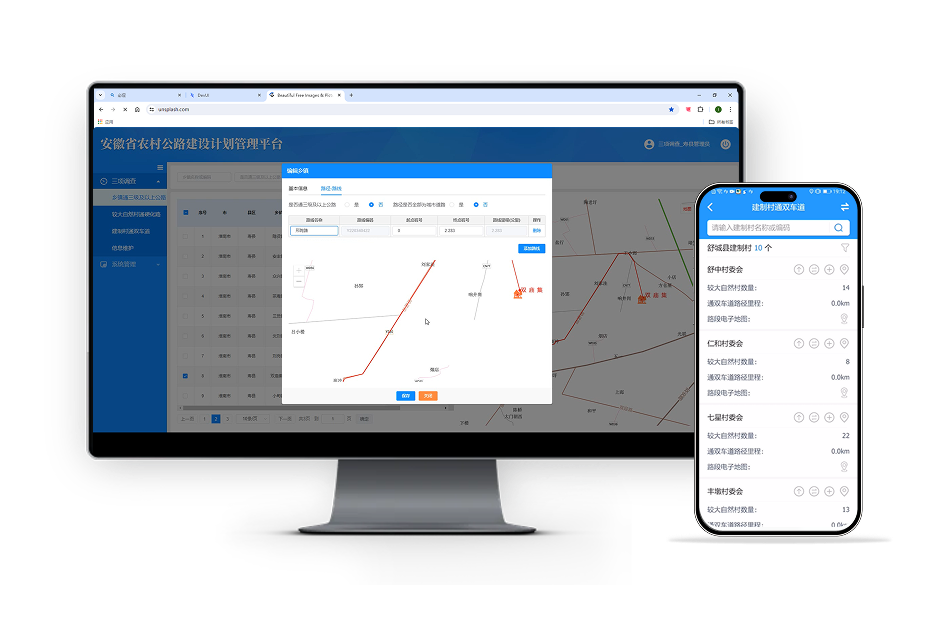
To better serve the needs of rural road construction across the province and further promote high-quality development of highways, our province has organized a survey and verification of the completion status of three objectives: connecting townships with Class III or higher highways, connecting larger natural villages (20 households or more) with paved roads, and connecting administrative villages with two-lane highways. This comprehensive survey aims to clarify the current situation, identify shortcomings and weaknesses, and provide accurate data for scientifically planning rural road construction in the later stages of the 14th Five-Year Plan, optimizing fund allocation, and formulating categorized promotion policies. This will help build a widely covered, structurally sound, safe, and convenient rural road network.
Demonstration and guidance
Set benchmarks, deepen applications, replicate best practices, and promote comprehensively.
-
Standardization Promotion
Develop a unified data verification work plan, clarify the scope of investigation, verification standards, work processes and division of responsibilities, and ensure that the work is carried out in a consistent manner and the results are comparable throughout the province.
-
Multidimensional verification
The method of "on-site verification + remote sensing image comparison" was adopted to comprehensively verify the authenticity of the route, the rationality of the selection, and the accuracy of the indicators.
-
Hierarchical linkage
A four-level linkage mechanism has been established, with provincial-level overall coordination, city and county-level implementation, and township-level assistance and cooperation, forming a work pattern that is interconnected and highly efficient.
-
Information technology support
By relying on the information system, we can realize online submission, real-time updates and dynamic management of information for preliminary investigation and verification, thereby improving work efficiency and data quality.
Application effectiveness
Quantifiable management effectiveness and public value; more efficient regulation; more valuable data.-

Get a clear understanding of the current accessibility situation across the province
The data collection and verification for the three tasks were fully completed, and a database of rural road accessibility covering the entire province was established, providing a solid foundation for policy formulation and planning.
-

Supporting scientific planning of road networks
Based on the preliminary survey results, the mileage of substandard road sections, the scale of population benefit and investment needs are accurately calculated to support the dynamic optimization of the rural road construction project database and the precise arrangement of annual plans.
-

Serving rural revitalization and development
Focusing on improving accessibility in townships, natural villages, and administrative villages, we will effectively improve travel conditions in rural areas, serve rural revitalization, and enhance the people's sense of gain and happiness.
