


Project Overview
Since 2022, the company has been providing automated testing and assessment services for the technical condition of rural road surfaces to numerous county-level road administration and maintenance units. The company's independently developed lightweight testing equipment has passed national metrological certification, and its testing accuracy meets the technical parameter requirements of the Ministry of Transport's standards.
By utilizing vehicle-mounted inspection equipment, image and sensor data fusion, automated defect identification and grading algorithms, and an integrated data management platform, a closed-loop workflow covering data collection, analysis, assessment, and reporting has been established. Compared to the cumbersome procedures of traditional segment-by-segment inspection, such as route finding, location determination, data recording, and dedicated personnel operation, the non-stop continuous field inspection mode significantly improves inspection efficiency. The average daily inspection mileage per vehicle can reach 100 kilometers, and the inspection path can be viewed in the background.

Demonstration and guidance
Using mature applications as models, we will develop replicable and scalable practical pathways for intelligent detection on rural roads.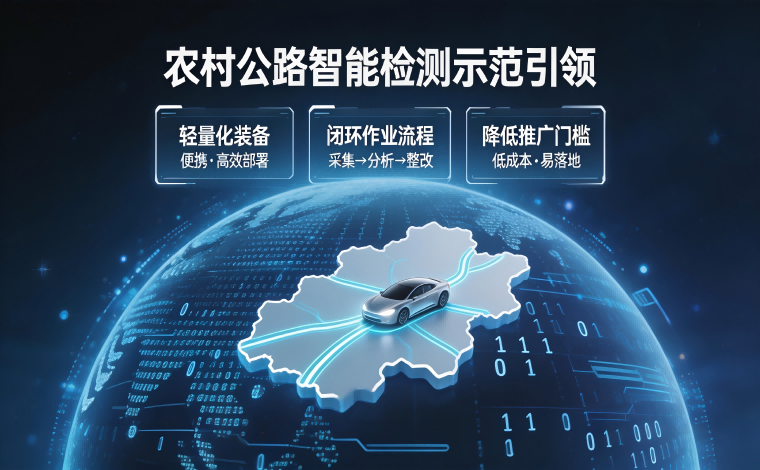
-
Forming a practical application model in the county
The project has been continuously implemented in multiple county-level rural road management and maintenance units, forming a complete working model from inspection organization and data collection to results application. It has verified the feasibility and practicality of automated inspection in county-level rural roads and provided a reference implementation model for similar areas.
-
Lowering the barriers to promoting intelligent detection
By summarizing years of service experience across multiple regions, we have developed standardized operating procedures, technical approaches, and deliverable systems. This allows the project model to be flexibly replicated in different regions based on road network scale and management needs, reducing the technical and management costs of implementing intelligent detection in new areas.
-
Promote the transformation of rural road management methods
Based on the effectiveness of project application, we will promote the transformation of rural road condition management from "manual inspection and experience judgment" to "data support and intelligent decision-making", help local road administration and maintenance departments improve their management level, and promote the continuous development of rural road maintenance management towards digitalization and informatization.
Application effectiveness
By continuously applying and validating the value of the technology, we can comprehensively improve the level of rural road maintenance and management.-

Significant management results
Relying on a systematic data collection and intelligent analysis platform, the entire road condition can be viewed and managed in a unified manner, enabling maintenance decisions to shift from experience-based judgment to data-driven approaches, and significantly improving the level of management precision.
-

Improve work efficiency
By adopting vehicle-mounted continuous detection and intelligent recognition technology, the traditional manual segmented operation is upgraded to automated mobile operation, which improves the detection efficiency several times and realizes high-frequency and full-coverage monitoring of the road network.
-

Cost and quality optimization
By replacing intensive manpower with automated detection, fieldwork costs are significantly reduced while ensuring the objectivity of disease identification and the accuracy of assessment results, achieving a balance between cost reduction and efficiency improvement and quality enhancement.
